
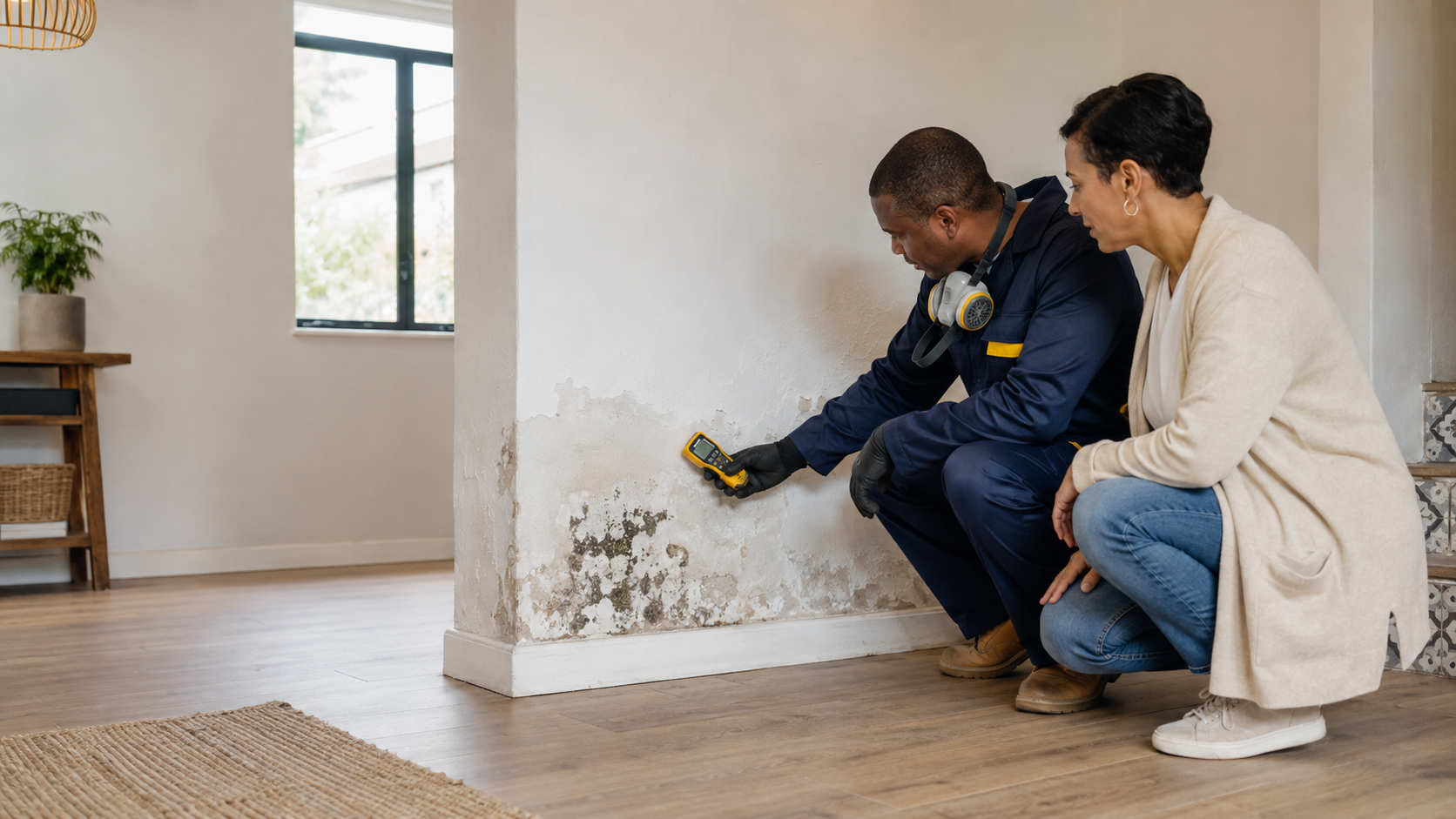
Damp and mould in a rental property is not just an ugly wall or a tenant complaint to “wipe down”. For a landlord, it can become a health issue, a maintenance dispute, a deposit argument and a recurring repair bill if the cause is not found properly.
In Gauteng, we see the same pattern often: summer thunderstorms expose weak roof details, blocked gutters overflow into walls, poorly drained paving pushes water against foundations, bathroom steam condenses on cold surfaces, or a small plumbing leak runs quietly behind a cupboard. The mould is the visible symptom. The water source is the real problem.
The Build Guy’s fundamental lesson from damp proofing projects is simple: a decorative coating or chemical injection will always fail if you do not accurately diagnose and stop the root source of the water first. This article explains what South African landlords should check, what to document, when waterproofing makes sense, and where a tenant issue can become a legal or tribunal matter. It is practical guidance, not legal advice.
Why landlords should take damp and mould seriously
Mould needs moisture. The National Department of Health’s Guideline for the Management of Domestic Indoor Air Quality states that moisture control is the main method for controlling mould and allergens, and recommends cleaning and drying wet building materials and furnishings within 24 to 48 hours to prevent mould growth. That is a useful benchmark for landlords: delays make the problem harder to fix.
Health effects vary by person, but damp and mouldy environments are associated with irritation and respiratory symptoms, especially for people with asthma, allergies, chronic lung disease, young children, older people and immune-compromised occupants. International health guidance from the CDC gives similar warnings. A landlord does not need to diagnose anyone’s health; the responsible approach is to remove the moisture source and remediate the affected materials.
For Gauteng property owners, timing matters. The South African Weather Service notes in its Regional Weather and Climate of South Africa: Gauteng document that the province has a high likelihood of strong thunderstorms in late spring and early summer. In plain terms: if gutters, roof valleys, parapets, flashings, box gutters, paving falls or retaining walls are marginal, the rainy season will usually find the weakness.
South African landlord duties: the practical legal position
The Rental Housing Act 50 of 1999 is the main national statute dealing with residential rental housing. Government describes the Act as creating mechanisms for proper functioning of the rental market, Rental Housing Tribunals and general requirements for leases. The 2008 Rental Housing Unfair Practices Regulations say a landlord must maintain the outside of the dwelling, including walls and roof, in good order and repair; maintain plumbing, sanitary, heating, ventilation and related systems; and effect repairs for which the landlord is responsible after inspection or written notice from the tenant, generally within 14 days or a further agreed period.
Important legal note for 2026: the Rental Housing Amendment Act 35 of 2014 includes wording about a landlord providing a dwelling in a habitable condition and maintaining the existing structure, but the official government page still states that commencement is to be proclaimed in the Government Gazette. Because commencement details can affect enforcement, landlords should verify the current legal position with a qualified South African attorney or the relevant Rental Housing Tribunal before relying on a specific section number in a dispute.
For Gauteng matters, the Gauteng Rental Housing Tribunal says it resolves disputes between landlords and tenants in residential dwellings and lists lack of maintenance and repairs among the complaints it can deal with. The City of Tshwane also describes the Tribunal as a statutory body that handles unfair rental practice complaints. In other words, ignoring a damp complaint is not a good strategy.
First decide what kind of damp you have
Before you paint, inject, seal or replace cupboards, identify the moisture path. Most rental damp problems fall into one or more of these categories.
Roof, flashing and gutter leaks
Typical signs include ceiling stains, mould at cornices, water marks below parapets, damp around skylights, or peeling paint high on external walls. Common causes include cracked roof sheets or tiles, failed ridge details, loose flashings, blocked gutters, undersized downpipes, box gutter defects and water running back under roof edges during heavy storms.
Lateral damp through walls
This is common where soil, paving, garden beds or retaining walls sit against the building. Water pushes sideways through masonry or plaster. You may see blistering paint, salt deposits, damp skirting boards, swollen cupboards or mould behind furniture. A coating on the inside wall is rarely a lasting fix if outside ground levels and drainage are wrong.
Rising damp
Rising damp usually shows low on walls, often with powdery salts, failing plaster and paint damage above skirtings. It may be linked to a failed or bridged damp-proof course, external paving installed too high, planter boxes against walls, or poor subfloor drainage. Chemical injection may help in specific cases, but it is not a cure for every low-level damp mark.
Plumbing leaks
Leaks can come from shower outlets, bath traps, toilet connectors, concealed pipes, geyser overflow pipes, kitchen waste lines or cracked grout and failed silicone. A small leak can create serious mould if it runs into built-in cupboards or behind tiles.
Condensation and poor ventilation
Condensation is moisture from indoor air settling on colder surfaces. It often appears in bathrooms, kitchens, bedrooms with poor airflow, overcrowded rooms, or units where laundry is dried indoors. It can be made worse by building defects, but tenant behaviour can also contribute. Handle this carefully: do not blame the tenant until leaks, waterproofing defects and ventilation failures have been checked.
A landlord’s step-by-step response
1. Acknowledge the report and ask for evidence
Ask the tenant for dated photos, rooms affected, when it appears, whether it worsens after rain, whether there is a smell, and whether any personal belongings are affected. Keep communication in writing. This protects both sides and helps the contractor diagnose faster.
2. Inspect the property, not only the mould patch
A proper damp inspection should include the roof, gutters, downpipes, stormwater flow, paving falls, external walls, bathrooms, kitchens, plumbing points, ceilings, built-in cupboards and ventilation. In sectional title units, also check whether the suspected source falls under body corporate responsibility, such as common property roofs, external walls or balconies.
3. Stop active water first
If there is an active leak, stop it before cosmetic work starts. That may mean clearing gutters, repairing flashings, fixing a plumbing leak, improving drainage, cutting back soil against walls, correcting paving falls or opening a wall to trace a pipe. Repainting before this step is wasted money.
4. Dry, clean and remove damaged material where needed
Once the source is stopped, affected areas need drying. Some materials can be cleaned; others, such as swollen chipboard, mouldy cupboard backs, badly damaged skirting or contaminated ceiling boards, may need replacement. The Department of Health’s 24 to 48 hour drying guidance is a reminder that moisture delays increase mould risk.
5. Repair the building envelope properly
This is where construction judgement matters. A balcony may need falls corrected, not just a new topcoat. A shower may need tile removal and waterproofing reinstated behind the finish. A retaining wall may need drainage and a suitable waterproof barrier on the soil side. A roof joint may need membrane reinforcement, not just a smear of sealant.
6. Finish only when dry readings and site conditions make sense
Professional opinion: landlords often lose money by rushing final paint. Paint can trap residual moisture and blister again. Where possible, allow drying time, check whether the smell has cleared, and confirm that new stains are not forming after rain or water use.
Where waterproofing products help, and where they do not
Waterproofing products are useful when they are matched to the defect, substrate and exposure. They are not magic. A product cannot compensate for poor drainage, moving cracks, rotten timber, a failed roof structure or water trapped behind an internal wall.
For suitable damp and waterproofing applications, The Build Guy often considers bitumen-based systems where a tough, flexible barrier is needed. A user-verified product example is Duram Durabit Bitumen Waterproofing Black 20L. The Chamberlains listing states that it forms a durable, tough, flexible and elastic waterproof membrane; is water-based and non-flammable; can be built up to a thick, impenetrable membrane; does not affect or taint water once dry, with one initial flush recommended; is suitable for permanent immersion in water; cleans with water while wet; and protects the substrate from degradation.
The Duram technical datasheet describes Durabit as a water-based bituminous waterproofing coating suitable for uses such as water features, cement dams, box gutters, retaining and cavity walls, roof joints and screws, and behind tiles. That does not mean it is automatically correct for every damp wall. The substrate must be prepared, compatible, dry enough for the system, and detailed correctly at joints, corners and terminations.
Documentation landlords should keep
Good records reduce conflict. Keep the lease, incoming inspection report, photos, tenant messages, contractor findings, moisture notes if taken, invoices, product datasheets and before-and-after photos. If the issue is linked to tenant behaviour, document the facts carefully: blocked vents, furniture tight against wet walls, indoor laundry without ventilation, or refusal of access. If the issue is building-related, do not frame it as tenant negligence.
The current Rental Housing Act also deals with incoming and outgoing inspections, which are important when deposits are disputed. Damp that existed at occupation, or defects noted early and not repaired, should not be treated the same as damage caused by a tenant. Where the facts are contested, get legal advice or approach the Tribunal rather than making aggressive deductions.
Tax and budgeting note for rental owners
For tax, SARS distinguishes between repairs or maintenance and improvements. Its tax on rental income guidance says the facts and circumstances must be examined, and that improvements are not allowed as a deduction against rental income in the same way as repairs, although they may affect base cost for capital gains tax purposes. Speak to a South African tax practitioner before assuming a damp project is deductible.
When to call a contractor
Call for a site-specific assessment when mould returns after cleaning, damp worsens after rain, paint blisters repeatedly, skirtings swell, a room smells musty, cupboards are affected, tenants report health concerns, or you cannot identify whether the source is roof, plumbing, drainage or condensation. Also call before buying a “one-size-fits-all” damp product.
If your rental property is in Centurion, Pretoria East, Midrand, Kyalami, Sandton, Bryanston, Randburg, Roodepoort, Montana, Wonderboom or the Moot, The Build Guy can assess the site conditions and quote on practical repairs. The sensible next step is not another coat of paint; it is a clear diagnosis, a repair plan and a finish that suits the actual water source.
Frequently asked questions
Is mould always the landlord’s responsibility?
Not always. If the mould is caused by a building defect, roof leak, plumbing leak, failed waterproofing or poor external drainage, the landlord will usually need to address the source. If it is caused only by tenant behaviour, such as no ventilation or repeated indoor drying without airflow, the tenant may carry some responsibility. In practice, inspect first and document the cause before blaming either party.
Can I just paint over mould before a new tenant moves in?
No. Painting over mould without stopping the moisture source is a short-term cosmetic cover-up. Clean and dry the affected area, remove damaged material where needed, repair the leak or damp source, then repaint with a suitable system only once the substrate is ready.
How quickly should a landlord respond to a damp complaint?
Respond as soon as reasonably possible and keep written records. The 2008 Rental Housing Unfair Practices Regulations refer to repairs for which the landlord is responsible generally being effected within 14 days after inspection or written notice, or within a further agreed period. Active leaks and health-related mould concerns should be treated as urgent maintenance issues.
Is Duram Durabit the right product for every damp wall?
No. Duram Durabit is a useful bituminous waterproofing product for suitable applications such as retaining walls, box gutters, roof joints and behind tiles, according to supplier information. It is not a substitute for fixing drainage, roof defects, plumbing leaks or poor surface preparation. Product choice should follow diagnosis.
Should I approach the Gauteng Rental Housing Tribunal?
If a landlord and tenant cannot resolve a maintenance dispute, the Gauteng Rental Housing Tribunal is a formal route for residential rental disputes, including lack of maintenance and repairs. It is still wise to collect photos, dates, notices, inspection notes and contractor reports before lodging or responding to a complaint.
Sources and further reading
- Rental Housing Act 50 of 1999 | South African Government — The Act establishes the framework for residential rental housing, leases and Rental Housing Tribunals in South Africa.
- Rental Housing Unfair Practices Regulations, 2008 | South African Government — Regulations include landlord obligations relating to exterior walls and roofs, plumbing and repairs after inspection or tenant notice.
- Rental Housing Amendment Act 35 of 2014 | South African Government — Official government page states commencement is to be proclaimed, so legal reliance on amended obligations should be verified.
- Gauteng Rental Housing Tribunal information leaflet — The Tribunal handles landlord-tenant disputes in Gauteng, including lack of maintenance and repairs.
- National Department of Health: Guideline for the Management of Domestic Indoor Air Quality — Moisture control is the main mould control method; wet building materials and furnishings should be cleaned and dried within 24 to 48 hours.
- CDC: Mold health information — Damp and mouldy environments may cause respiratory and irritation symptoms, with higher risk for vulnerable groups.
- South African Weather Service: Regional Weather and Climate of South Africa – Gauteng — Gauteng has a high likelihood of strong thunderstorms in late spring and early summer, relevant to roof and drainage maintenance.
- Chamberlains: Duram Durabit Bitumen Waterproofing Black 20L — Supplier listing provides product properties including flexible membrane formation, water-based composition and suitability for permanent immersion once dry.
- Duram Durabit technical datasheet — Datasheet describes intended uses such as box gutters, retaining and cavity walls, roof joints and behind tiles.
- SARS: Tax on rental income — SARS distinguishes between repairs/maintenance and improvements based on facts and circumstances for rental income tax purposes.